

Wedding bouquet preservation and colour: What nobody tells you before entrusting your flowers.
What over 1,000 Pieces have taught us about preserving flowers.
Floral preservation is a young art. In France, techniques are evolving, expertise is being built, and knowledge about how flowers behave over time accumulates with every creation.
Over the past five years, our atelier has received more than 1,000 bouquets. Each species, each composition, each environment has contributed to a deeper understanding of what floral matter actually does over time. This is the perspective we want to share here.
What floral matter has taught us
Structure is preserved
A preserved flower retains its form with remarkable fidelity. Its volumes, its texture, its architecture : preservation halts deterioration and locks structure in time.
Pigments, however, evolve
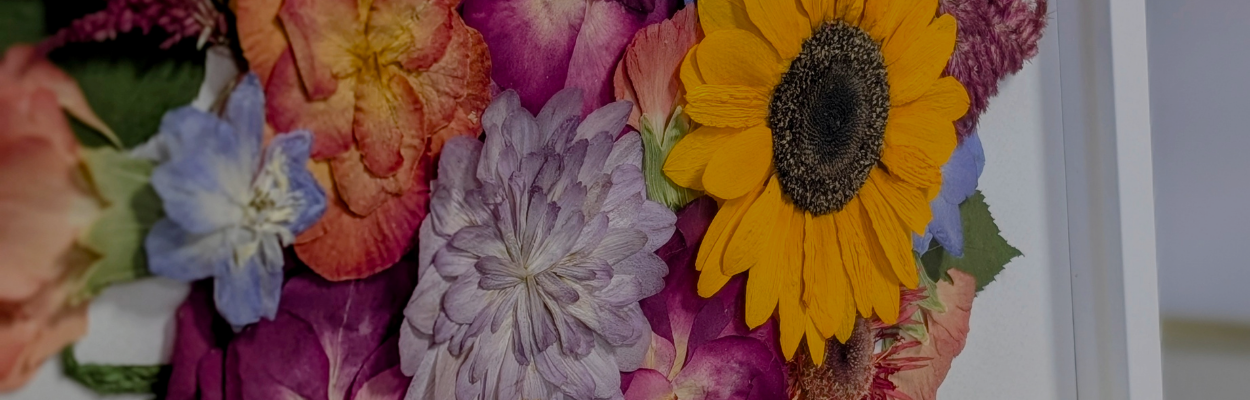
Pigments, by contrast, are alive. They respond to their environment: light exposure, humidity, heat, thermal variations, even the quality of the surrounding air influence how they hold over time. A deep burgundy rose shifts toward amber. A pale pink peony fades toward beige. White flowers take on a honeyed or ivory tone.

This phenomenon is inherent to organic matter. It is not the result of any particular technique, it applies to every preserved flower, regardless of method.
UV glass : a precise and well-understood role
UV-protective glass plays a real and necessary role: it shields flowers from light exposure, one of the most active factors in pigment degradation.
We use 99% anti-UV glass : the same standard used in major museums for their permanent collections. But over years of observation, we have learned that light is only one of the factors at play. Humidity, heat, and the everyday variations of a living environment act independently of light protection.
This is why, at Les Joyaux Purs, the glass protects the chromatic restoration itself, not only the flowers. The two form an inseparable system.
Chromatic restauration : our response to the nature of the material
Faced with the reality of floral pigments, we developed an approach that acts on colour itself, after the preservation phase.
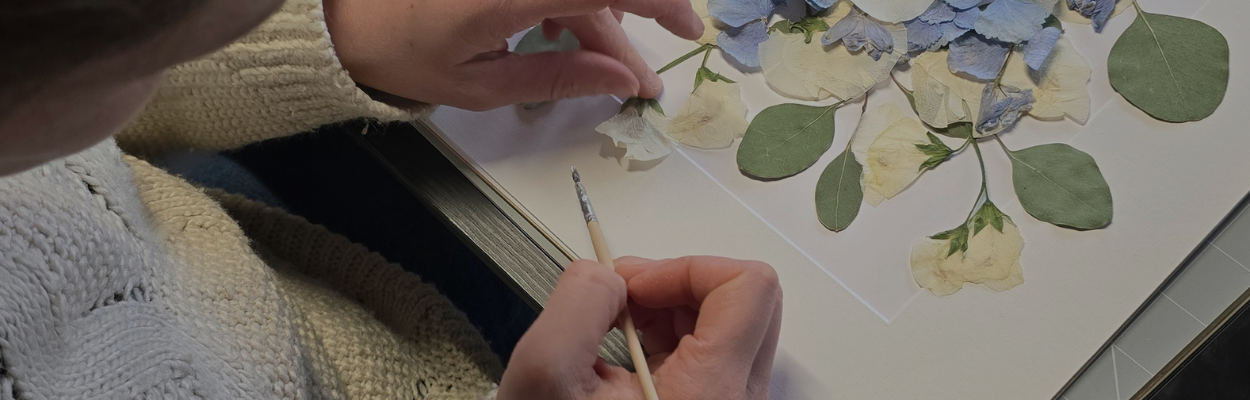
Chromatic restoration is an artistic gesture performed from your wedding photographs. Each flower is reworked species by species, with precise knowledge of how each variety preserves. This work requires between 4 and 6 hours per wedding bouquet.

Our ambition is not perfect reproduction. Colour remains a living material, and restoration a human gesture. Our ambition is maximum fidelity: to render, as precisely as possible, the chromatic intensity of your bouquet as it was on your wedding day.
Our promise for your memory
From the ephemeral to the eternal, that is our promise. And eternity, when working with living matter, is built gesture by gesture. Chromatic restoration is one of them.
The environment of your piece
A floral artwork, like any work of art, lives within an environment. Heat, humidity, thermal variations, cigarette smoke : all of these act on the material over time.
A stable room, away from direct heat sources and humidity fluctuations, is the ideal setting to preserve the intensity of your creation through the years.
From the Ephemeral to the Eternal : Transforming your bouquet into a lasting memory
Our Collections
Every Les Joyaux Purs creation shares the same artistic standard: chromatic restoration and 99% anti-UV museum glass. What differs between our collections is the experience surrounding the artwork: the frame materials and the level of service.
L'Écrin, The three-dimensional floral sculpture. Artisan cabinetry, White Glove service. From €1,550.
Le Florilège, The pressed botanical frame. Artisan cabinetry, White Glove service. From €2,150.
L'Origine, The three-dimensional floral sculpture. The same artistic standard, artisan frame, shipped directly to the atelier. From €650.

Le Florilège, 50x40

Leave a comment
This site is protected by hCaptcha and the hCaptcha Privacy Policy and Terms of Service apply.